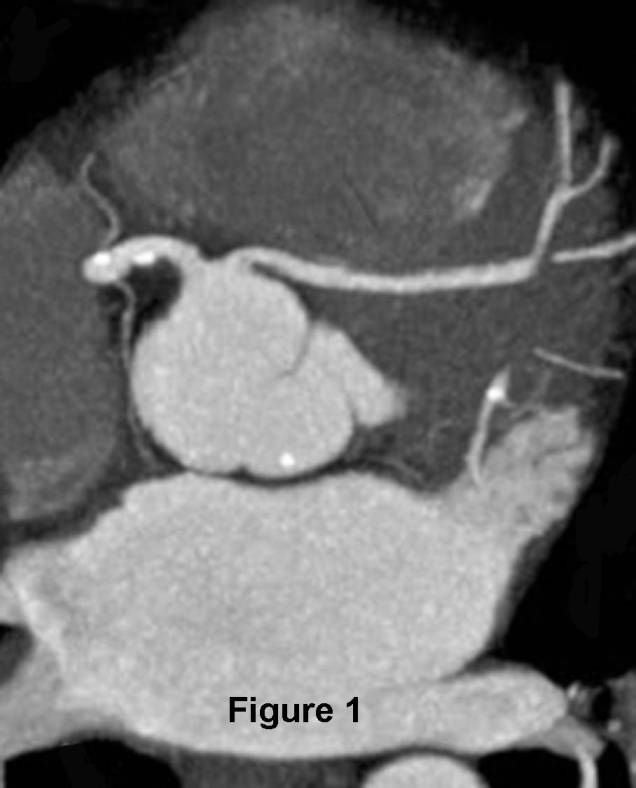
Radiologic Findings Single contrast-enhanced image from a coronary CTA (Fig. 1) reveals an anomalous origin of the left coronary artery from the right coronary cusp of the aorta. The left coronary artery then follows an inter-arterial course between the ascending aorta and the pulmonary artery. Further distally, a short segment of the left anterior descending coronary artery courses into the myocardium rather than across the epicardial surface. Non-obstructing plaque is seen in the right coronary artery. Answer Diagnosis: Anomalous Origin Left Coronary Artery with Inter-arterial Course (Malignant Variant); Short Segment Myocardial Bridging
Anomalous Origin Left Coronary Artery with Inter-arterial Course (Malignant Variant); Short Segment Myocardial Bridging
Differential Diagnosis
None
Discussion
Coronary arteries can have anomalous origins and courses. The left main (LMC) or left anterior descending coronary artery (LAD) can originate from the right or non-coronary cusps of the ascending aorta. The “benignity” or “malignancy” of such anomalous origins depends on the subsequent course of the vessel and are characterized as follows:
Inter-arterial Course: Coronary artery courses between the ascending aorta and the pulmonary artery. The vessel is subject the compression during exercise which may result in angina, myocardial infarction, and sudden death (malignant variant).
Intra-septal Course: The anomalous vessel courses between the aorta and the right ventricular outflow tract and takes an intramyocardial course in the interventricular septum giving off septal branches. The visualization of septal perforators from the anomalous vessel is the clue to the correct diagnosis (benign variant).
Retro-aortic Course: This variant more commonly involves the circumflex coronary artery, but can also involve the left main coronary artery. It is not associated with sudden death (benign variant).
Pre-Pulmonary Course: This variant is more commonly seen in patients with tetralogy of Fallot. Although considered a benign variant, the major danger exists at the time of midline sternal splitting thoracotomy during which time the anomalous vessel may be inadvertently transected.
Myocardial Bridging: Myocardial bridging is more often diagnosed on coronary CTA than on conventional transcatheter coronary angiography. It occurs when the one of the coronary arteries travels through and is surrounded by myocardial muscle rather than coursing along the top of the epicardial surface.T he prevalence is estimated at 30%, but less than 5% of affected patients are symptomatic. It is currently believed that those patients with long and deep tunneled segments have a higher incidence of ischemia. Although still somewhat controversial, some authorities suggest bridging should be managed surgically whereas others advocate medical management.
Selected Readings
- Kim SK, Seo JB, Do KH, et al. Coronary Artery Anomalies: Classification and ECG-gated Multi-Detector Row CT Findings with Angiographic Correlation. RadioGraphics 2006; 26: 317-333.
- Tuncer C, Batyraliev T, Yilmaz R. et al. Origin and Distribution Anomalies of the Left Anterior Descending Coronary Artery in 70, 850 Adult Patients: Multi-Center Data Collection. Catheter Cardiovasc Interv 2006; 68: 574-585.
can you purchase viagra online where to purchase viagra trusted viagra sites generic ed medication buy amoxicillin cheap generic viagra online amoxicillin buy can you purchase viagra online where to purchase viagra trusted viagra sites generic ed medication buy amoxicillin cheap generic viagra online amoxicillin buy can you purchase viagra online where to purchase viagra trusted viagra sites generic ed medication buy amoxicillin cheap generic viagra online amoxicillin buy can you purchase viagra online where to purchase viagra trusted viagra sites generic ed medication buy amoxicillin cheap generic viagra online amoxicillin buy
Original case written by its authors at Virginia Commonwealth University and published at this address as part of a weekly teaching collection. Reproduced here as an archive.