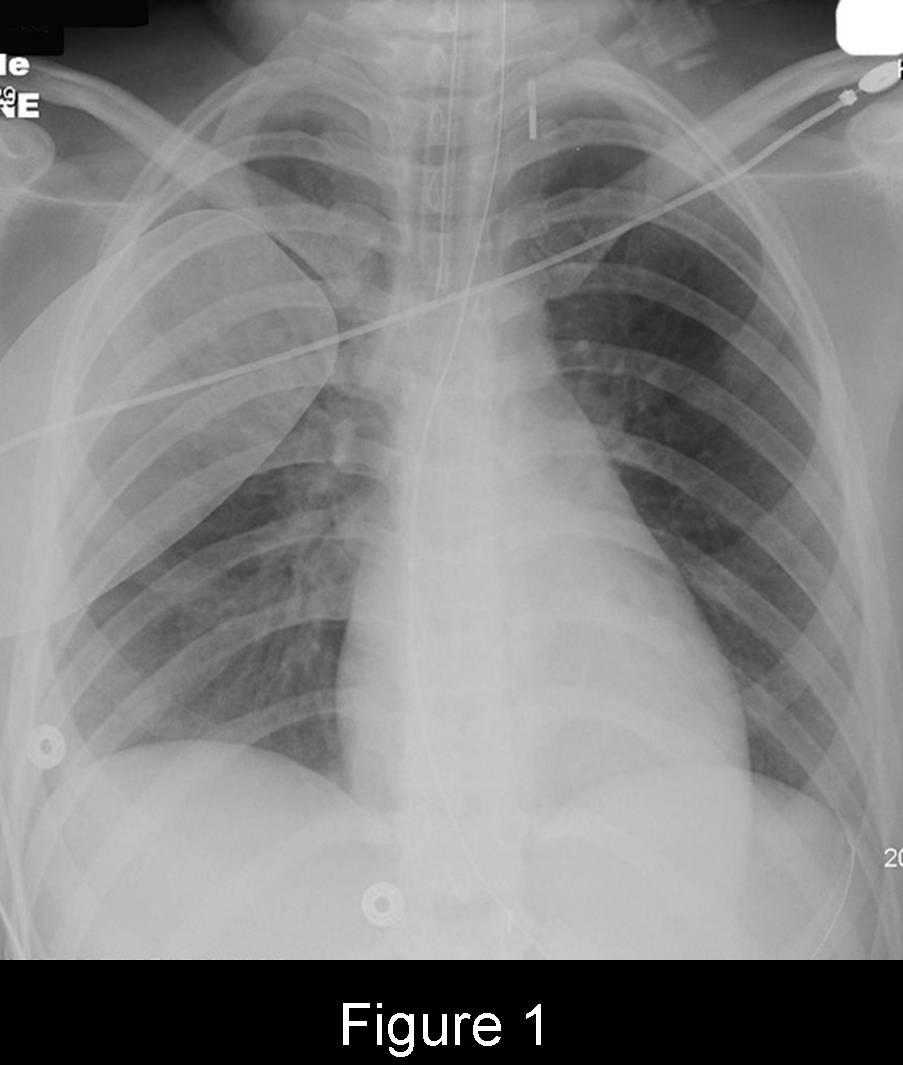
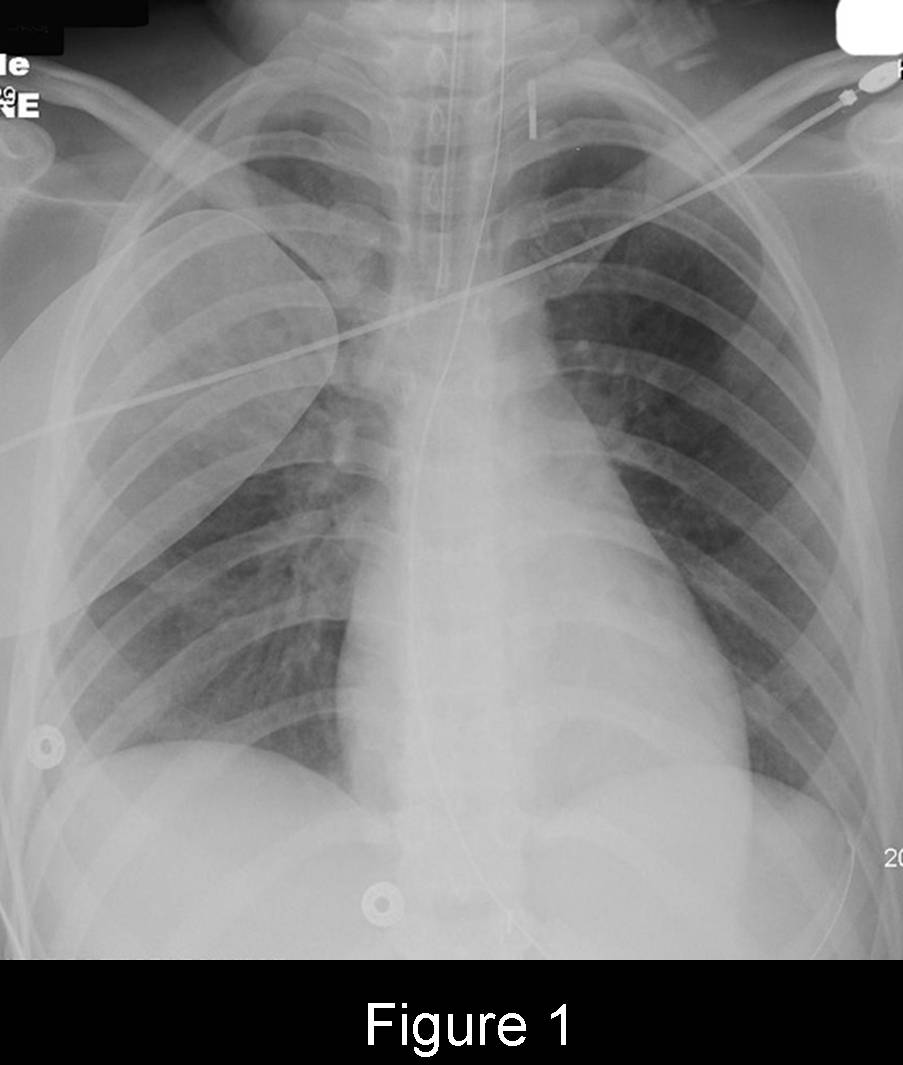
AP chest radiograph (Fig. 1) reveals a malpositioned intra-aortic balloon pump (IABP). The metallic marker indicates the device is positioned far too high overlying the expected location of the left common carotid artery. A transcutaneous pacer overlies the right chest wall. Mild right perihilar edema is present. The endotracheal tube and nasogastric tube are appropriately positioned. Diagnosis: Circulatory Assist Device: Malpositioned Intra-aortic Balloon Pump
Differential Diagnosis
None
Discussion
Circulatory assist devices were initially used to support patients in hemodynamic collapse. Today, these devices are used for a wide range of clinical conditions ranging from prophylactic insertion for invasive procedures to cardiogenic shock and cardiopulmonary arrest. The two most commonly employed devices are the intra-aortic balloon counterpulsation pump and the left ventricular assist device. This case emphasizes use of the former.
Intra-aortic balloon pump (IABP):
The IABP remains the most commonly used mechanical circulatory assist device. Its primary purpose is to increase myocardial oxygen supply while reducing its demand. Secondary purposes include improving cardiac output and ejection fraction, increasing coronary perfusion pressure and systemic perfusion, and reducing heart rate, pulmonary capillary wedge pressure, and systemic vascular resistance. Early indications for use included cardiac surgery, left ventricular failure, unstable angina, and failure to come off cardiopulmonary bypass. Prophylactic applications include stabilizing both cardiac and non-cardiac surgical patients. More recent applications include supporting cardiac patients during coronary angiography and percutaneous transluminal angioplasty, drug-induced cardiac failure, myocardial contusion, septic shock, and as a bridge to heart transplant.
Clinical Findings
IABP:
The 8.5-9.5F vascular catheter is introduced percutaneously via the femoral or axillary artery or directly into the descending thoracic aorta at thoracotomy. It is advanced retrograde just distal to the left subclavian artery. A 26-28 mm inflatable balloon is mounted on this vascular catheter. Helium gas is pumped from the bedside console to the balloon. The balloon inflates with the onset of diastole and deflates during isometric contraction or early systole and is phasically pulsed in counterpulsation to the patient’s cardiac cycle. Total or regional blood flow is improved during balloon inflation, as is collateral coronary artery circulation.
Complications
IABP:
Vascular complications are common and most often related to femoral or iliac injury. The most common vascular complication is limb ischemia (14-45%). Iatrogenic injury of the thoracic aorta is less common, but often fatal. Patients with extensive atherosclerotic disease are at increased risk. If the catheter is advanced too distal, it may obstruct blood flow to the aortic arch and its trifurcated vessels (Fig. 1). The latter may be associated with acute cerebral vascular accident. If the catheter is not advanced far enough, the counterpulsation is less effective and renal insufficiency may occur when the balloon occludes the renal arteries.
Imaging Findings
Chest Radiography
IABP:
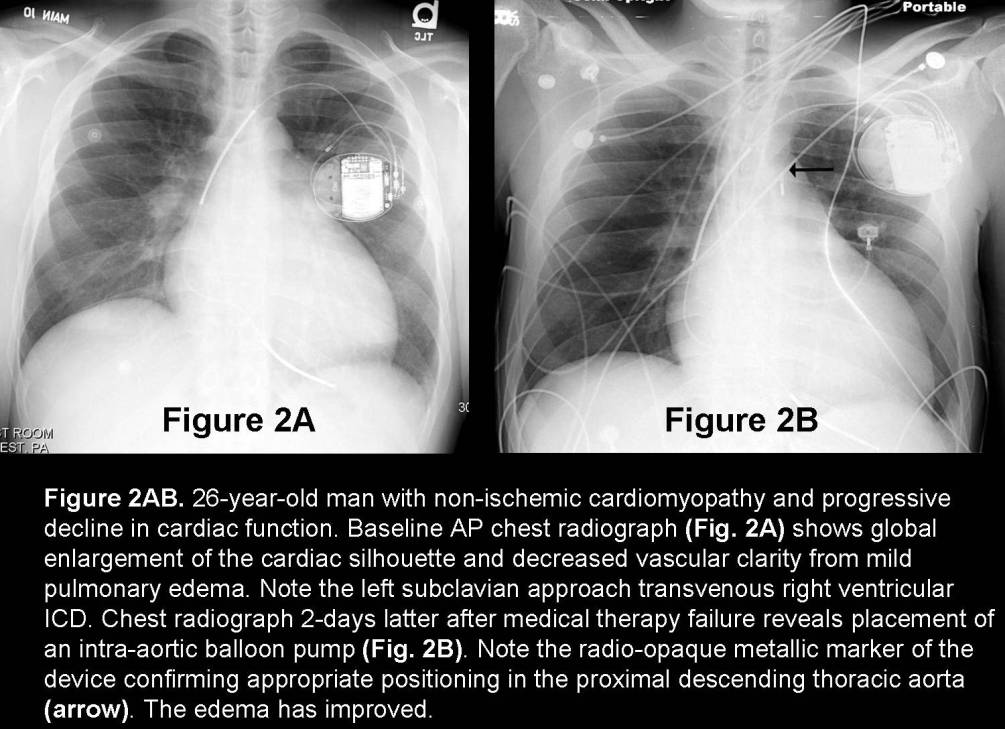
- Catheter tip is visible as an opaque 3 x 4 mm rectangle (Fig. 1 and Fig. 2B)
- Tip should be positioned in the proximal descending thoracic aorta, just below (i.e. 2.0 cm) the left subclavian artery take-off and superior contour of the transverse aorta (Fig. 2B)
Caveat: Envision the transverse aorta (i.e., aortic knob) as a rounded or oval target and place the radiopaque metallic marker (i.e. tip of the balloon device) in the center of the target or its bull’s eye.
- If the catheter is advanced into the aortic arch the opaque rectangular tip is foreshortened or appears as a radio-opaque ring
- Complicating dissection should be suspected when there is loss of definition of the descending thoracic aorta shadow
MDCT
- Catheter tip is visible as a high attenuation 3 x 4 mm rectangular metallic density in the aortic lumen
- Balloon may be visible depending on counterpulsation cycle
- Collapsed and not perceptible: systole
- Distended and gas filled: diastole
Prognosis
IABP:
- Early perioperative mortality rate for cardiac failure requiring IABP is as high as 52%. Pre-operative serum creatinine level, left ventricular ejection fraction, perioperative myocardial infarction, timing of balloon pump insertion, and indication for operation are independent predictors of early death
- Hospital survivors have a relatively good long-term prognosis
CAVEATS
IABP:
- Relative contraindications to use include severe aortic valvular insufficiency, known aortic dissection, and severe peripheral vascular disease
- Catheters positioned too high or too low should be promptly corrected
- Vascular perforations may require surgical repair or covered endovascular stents
Selected Readings
- Okuda M. A multidisciplinary overview of cardiogenic shock. Shock 2006; 26(6): 557-570.
- Santa-Cruz RA, Cohen MG, Ohman EM. Aortic counterpulsation: a review of the hemodynamic effects and indications for use. Catheter Cardiovasc Interv 2006; 67(1):68-77. Review.
- Trost JC, Hillis LD. Intra-aortic balloon counterpulsation. Am J Cardiol 2006; 97(9):1391-1398. Epub 2006 Mar 20. Review.
Original case written by its authors at Virginia Commonwealth University and published at this address as part of a weekly teaching collection. Reproduced here as an archive.